
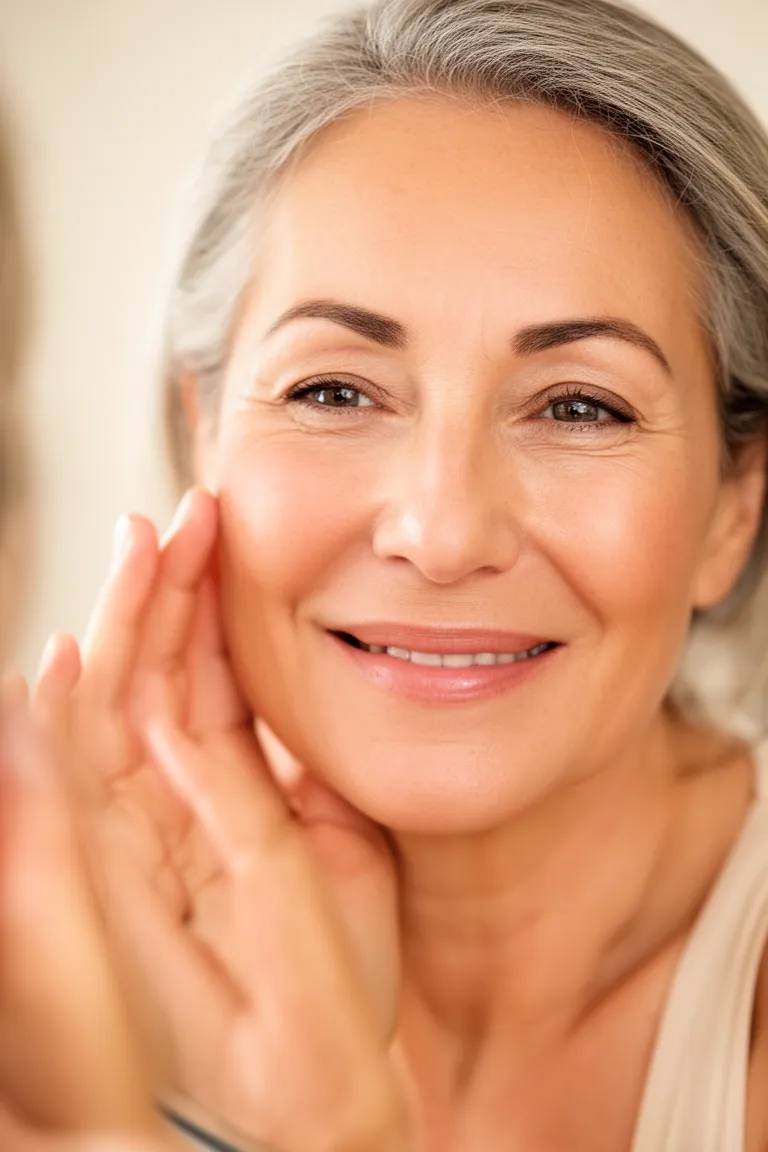
I was getting ready for a video call, the kind where you see your own face staring back at you the whole time. I leaned in to adjust my lamp, and in that unforgiving, close-up view, I saw it. My cheek didn’t snap back the way it used to when I smiled. It just… lingered. It was thinner, like the resilience had quietly packed its bags and left without a forwarding address. I sat back, stunned. I’m 47. I run three times a week. My diet is more vegetables than not. I’ve been a sunscreen devotee since my late twenties, for heaven’s sake. I did the homework. I followed the rules. So why did my skin look so fundamentally different?
The frustration was a slow burn. It felt deeply unfair. I’d invested in expensive firming creams, slurped collagen powders in my morning smoothie, and yet, the mirror told a story of gradual surrender. The creams gave a nice glow, a bit of plumpness that faded by noon. The powders? Who knows. The changes were so subtle I started to wonder if I was imagining them, or just desperately hoping my money wasn’t vanishing into a jar of scented lotion. I was the target customer for every “anti-aging” promise, yet I felt more skeptical and defeated with each purchase.
That moment before the call was my turning point. I realized I was asking the wrong question. I was asking, “What one product will fix this?” when I should have been asking, “What changed in my skin’s biology, and what can I actually do about it?” My journey to restore skin elasticity after 40 wasn’t about finding a miracle. It was about rebuilding a foundation I didn’t even know had crumbled.
The Morning I Realized My Skin Had Lost Its Bounce
That video call moment wasn’t about wrinkles. It wasn’t about a few new fine lines. This was something deeper, a quality I could only describe as “bounce.” Skin elasticity is that snap-back property, the structural integrity that keeps skin looking taut and lifted. It’s what makes a baby’s skin so resilient. In my 40s, I learned it’s also what quietly goes missing.
What skin elasticity actually means Think of your skin’s support system like a mattress. Collagen is the springs, providing structure. Elastin is the memory foam, giving it that bounce-back. For years, this system works perfectly. But over time, the springs weaken and the memory foam starts to flatten. No amount of fluffing the top layer (that’s your moisturizer) will fix a broken-down interior structure. That’s the core of the problem I was facing.
Why the change can feel sudden in your 40s You don’t lose collagen and elastin overnight. But there’s a tipping point. For years, your skin is efficiently repairing the daily micro-damage. Then, sometime in your 40s, the scales tip. The breakdown starts to outpace the repair. It’s like a slow leak in a tire you’ve been topping up for years—eventually, you look down and it’s just flat. That’s what happened to me. I’d been maintaining, but the underlying support structure was aging, and one day, the maintenance was no longer enough.
How laxity differs from dehydration, fine lines, and volume loss This distinction was my first step out of confusion. Dehydration is a lack of water; my skin could look papery and crepey, but a good hydrator would plump it up in hours. Fine lines are like cracks in paint. Volume loss is like deflating a balloon—the structure itself loses fullness. But laxity? That’s the balloon’s rubber itself becoming thin and overstretched. I could slather on hyaluronic acid and look dewy, but that was just adding water to a sponge—it didn’t repair the sponge itself. Understanding this helped me stop chasing the wrong solutions.
Why My Healthy Routine Wasn’t Enough to Restore Skin Elasticity After 40
This was the hardest pill to swallow. I felt a sense of personal failure. I was so proud of my healthy habits—the salads, the water, the workouts. But here’s what I learned: while my lifestyle was protecting my overall health brilliantly, it couldn’t single-handedly reverse a biological clock that had been ticking for decades. The game had changed, and I was still playing by the old rules.
Collagen and elastin decline with age By some estimates, we start losing about 1% of our collagen per year after our mid-20s. By the time I was noticing that lack of bounce, my body’s collagen factory was simply running at a slower, less efficient pace. It wasn’t producing faulty products; it was producing fewer of them. The same goes for elastin. My skin’s scaffolding was becoming more sparse and fragile, no matter how many kale smoothies I drank.
Cumulative UV exposure and solar elastosis This was the gut punch. I wore sunscreen, yes. But not perfectly. I’d forget to reapply during a long garden session. I’d skip it on a quick dog walk on a cloudy day. Those drives to school without sun protection on my left arm and cheek? They all counted. This cumulative damage leads to something called solar elastosis, where UV rays permanently degrade and tangle elastin fibers. My diligent sunscreen habit in my 40s was preventing new damage, but it was like closing the barn door after some very persistent horses had already left, years ago. It couldn’t erase the history written into my skin. [Functional integrity of aging skin, from cutaneous biology to anti-aging...
Menopause, thinner skin, and reduced oil production Then there’s the hormonal shift nobody prepared me for. As estrogen levels drop, it directly signals to your skin to slow down collagen production, produce less oil, and actually become thinner. My skin wasn’t just chronologically aging; its hormonal fuel supply was dwindling. This explained the new sensitivity, the dryness that seemed to come from nowhere, and why my skin felt more fragile.
Why hydration plumps temporarily but cannot rebuild deep structural support This is the great illusion. A brilliant hydrating serum can make my skin look plumper, smoother, and more radiant in 20 minutes. For a long time, I mistook that temporary plumping for real firmness. But it’s like putting a fresh, dewy coat of paint on a fence with rotting wood underneath. It improves the appearance dramatically, but it doesn’t fix the structural integrity. I was treating a symptom (dryness) and hoping it would cure the disease (laxity).
What I Tried First—and Why Firming Creams Disappointed Me
Armed with frustration and a credit card, I became a skincare guinea pig. My bathroom cabinet turned into a museum of expensive hope and quiet disappointment. I bought the creams with “lifting” and “firming” in bold, luxurious letters. I fell for the allure of peptides and bought a tiny bottle of serum that cost more than my monthly electric bill. The results were… fine. My skin felt smoother, looked a bit more radiant under perfect lighting. But that fundamental laxity, that loss of resilience when I turned my head, remained. I was left wondering, am I wasting money on firming creams for sagging skin? Are collagen boosting skincare products actually worth the money?
What moisturizers, hyaluronic acid, ceramides, and peptides can realistically do I had to get real about what each ingredient could actually deliver. Moisturizers with hyaluronic acid and ceramides are fantastic for one job: reinforcing your skin barrier and holding in water. They are essential for comfort and preventing transepidermal water loss, which makes everything worse. Peptides are like little messengers that can tell your skin to behave more youthfully; the science is promising, but the effects are subtle, gradual, and best seen over many months of consistent use. They’re supportive players, not the star quarterback.
Retinol versus prescription tretinoin for collagen support I dipped my toe into retinoids with over-the-counter retinol, expecting a miracle. When I didn’t see one in four weeks, I gave up. What I didn’t understand was the mechanism. Retinoids work by speeding up cell turnover and, crucially, by signaling to your skin to produce new collagen. This isn’t a surface fix; it’s a deep, cellular renovation project. And renovations take time. Prescription-strength tretinoin has more robust evidence, but the principle is the same: consistency over intensity.
Why topical collagen does not lift sagging skin This was my biggest “aha” moment. I slathered on creams boasting “collagen” as the star ingredient. Then I learned that collagen molecules are simply too large to penetrate deep into the dermis where new collagen is made. Applying it topically is mostly a surface-level moisturizing and film-forming effect. It might make skin feel nice, but it’s not rebuilding your internal support structure. The collagen has to come from within, either stimulated by actives like retinoids or supported by supplements.
How to evaluate collagen supplements and mixed evidence Desperate for an internal solution, I dove into the research on collagen supplements. The science is mixed but leaning positive for improving skin hydration and elasticity. The key is in the type: hydrolyzed collagen peptides are broken down small enough to be absorbed. Studies suggest a daily dose for several months may show modest benefits. I learned to see them not as a magic pill, but as a potential supportive piece of the puzzle—providing the raw materials once you’ve convinced your body to start building again with tools like retinoids and sunscreen.
Common mistakes: harsh exfoliation, excessive actives, and miracle claims My other huge mistake was impatience leading to self-sabotage. I’d introduce a retinol and use it every night, get red, flaky, and inflamed, and then give up entirely. Or I’d layer a new vitamin C, a peptide serum, and an exfoliating acid all in one week, overwhelm my skin barrier, and then blame the products for not working. I was attacking my skin, not nurturing it. I was so focused on restoring skin elasticity after 40 that I was burning down the village to save it.
The Shift: From Miracle Cures to Foundational Support
I finally threw out the idea of a single, magical solution. The question, “how to improve skin elasticity after 40 with retinol and sunscreen?” was getting closer, but it was still too narrow. I started thinking like a general contractor for my face. My job wasn’t to find one magical subcontractor; it was to manage the whole site: stop the ongoing damage, protect the workers (my skin cells), provide the right materials for repair, and be patient with the construction timeline.
This meant doubling down on what I knew worked, without glamour. My broad-spectrum SPF 30+ became a non-negotiable, every single day, rain or shine, winter or summer. This was no longer just about preventing wrinkles; it was about actively protecting the fragile, new collagen I was trying so hard to encourage. Sun exposure without protection would literally unravel the repair work in progress.
I also became religious about gentle cleansing. Stripping my skin with foaming washes or hot water was like starting every day by punching holes in my moisture barrier. It made my skin more vulnerable, more reactive, and made every active ingredient I applied more likely to cause irritation than benefit. I learned to love boring, repair-focused ingredients like niacinamide and ceramides, thinking of them as creating a calm, stable, and healthy construction site before I even thought about bringing in the heavy machinery.
The Routine That Finally Made My Skin Look More Resilient
This isn’t a glamorous or complicated routine. It’s a consistent, gentle, and deeply strategic one. It’s the routine I wish I’d started with when I turned 40 and my skin lost elasticity. It’s built on the understanding that you can’t pour all your effort into the attack (actives) and neglect the defense (protection and barrier).
Morning: Gentle Protection My morning is about defense and hydration. A lukewarm water rinse or the gentlest cream cleanser. A simple moisturizer with ceramides to reinforce my barrier. Then, my sunscreen—mineral-based, SPF 40, applied like it’s the most important step of my day (because it is). Some mornings, if my skin feels robust, I’ll use a vitamin C serum for its antioxidant protection, which helps my sunscreen work even better. But if my skin feels at all sensitive, I skip it. Simplicity wins.
Evening: Cleanse, Rebuild, and Support I double cleanse to thoroughly remove sunscreen and the day’s grime, starting with an oil or balm. Then, the cornerstone of my realistic routine for skin elasticity after 40: a retinoid. But I use it with a strategy. I started with an over-the-counter retinol, applying it one night a week, over the top of my moisturizer to buffer it. When my skin tolerated that for a full month, I moved to two nights. The goal was never to use it every night; the goal was to use it consistently, without wrecking my barrier, forever. This patience paid off more than any aggressive approach ever did.
On the other nights, I focus on barrier repair or use a peptide serum. I never mix actives. I listen to my skin. If it’s red, tight, or feels off, I take a night off and just slather on a rich moisturizer. This gentle, listening approach did more for my skin’s resilience and bounce in six months than a full year of frantic product-hopping ever did. How to firm loose skin on face and neck even though I use sunscreen.
| Approach | Best For | Realistic Timeline for Visible Change | Key Consideration |
|---|---|---|---|
| Barrier-Focused Basics (SPF, gentle cleanse, moisturizer) | Anyone starting out, or with very sensitive/reactive skin. Addresses dehydration and protection. | 1-4 weeks for improved hydration and calm. | Essential foundation, but won’t significantly rebuild collagen on its own. |
| Foundational + One Active (e.g., Retinoid OR Peptides) | Those ready to strategically stimulate collagen after establishing a solid base. | 3-6 months for subtle improvements in firmness and texture. | Patience is non-negotiable. Consistency with one proven active is key. |
| Combined Topical & Internal Support (Routine + Supplements) | Individuals seeking a multi-angle approach after mastering a topical routine. | 4-6 months+ for potential cumulative, subtle benefits. | Manage expectations. Supplements are supportive, not transformative, and require quality and consistency. |
| Professional-Guided Pathway (Topical + In-Office Procedures) | Addressing significant laxity where topical care has reached its realistic limit. | Varies by procedure; often requires a series of treatments and downtime. | An investment in time and resources. Crucial to consult a board-certified dermatologist. |
Scientific Evidence
How Long Skin Elasticity Changes Actually Take After 40
This is where you need radical, sometimes brutal, honesty. When I began this foundational routine, I saw hydration effects within days. My skin looked plumper, smoother, more glowing. But I had to train myself to understand: that’s not restored elasticity—that’s a well-hydrated surface. It’s the paint job, not the new wood.
The real structural changes operate on a different clock. With my retinoid, I was told to expect a minimum of three months to see subtle improvements in firmness and fine lines. For me, it was closer to five months before I noticed my skin had a bit more “spring” when I pressed it, and the fine lines around my eyes looked just a little softer. Collagen takes time to build. If you’re considering supplements, the research suggests a similar 3-6 month window for any potential subtle improvements in skin hydration and elasticity.
This timeline forced me to adjust my expectations from “transformation” to “meaningful improvement.” I wasn’t going to look 30 again. But I could look like a more resilient, healthier, and brighter version of 47. My skin looks firmer, more even, and has recaptured some of that bounce-back quality I thought was gone forever. It’s not a dramatic reversal, but it’s a real, tangible improvement that expensive creams alone never delivered.
When to Consider Professional Help (And It’s Okay To)
The final, liberating part of my journey was accepting the honest limits of topical skincare. No cream, no matter how expensive or beautifully marketed, can significantly lift sagging skin. It just can’t. The skin’s dermal layer and the underlying facial fat pads are simply too deep for topical ingredients to meaningfully restructure.
So, while my consistent routine has given me back a wonderful level of resilience, glow, and improved firmness, I’ve also had candid, unemotional conversations with a dermatologist. For deeper laxity or more dramatic results, procedures like microneedling, radiofrequency, laser treatments, or ultrasound can reach those deeper layers to stimulate collagen in a way no cream ever could. Skinception review before and after.
I now see these options not as a failure of my diligent routine, but as the next logical step in a layered maintenance plan. Seeing a professional helped me understand my skin’s unique anatomy, set realistic goals, and take the emotional weight out of the equation. It turned a personal frustration into a practical plan.
Frequently Asked Questions

Q: How long does it really take to see results when trying to improve skin elasticity after 40? A: You have to separate hydration from structural change. Better hydration and a healthier glow can appear in days to weeks. But true improvements in elasticity and firmness from collagen-building ingredients like retinoids take consistent, patient use—typically three to six months to see subtle but noticeable results. It’s a marathon, not a sprint. Setting this long-term expectation was the key to my patience.
Q: I’ve heard collagen supplements don’t work. Is it worth trying them? A: The evidence is evolving and now leans toward a supportive role. Current research suggests certain hydrolyzed collagen peptides can be absorbed and may support skin hydration and elasticity over time. The key is managing expectations: they are a supportive player in the background, not the star of the show. If you try them, look for a reputable product with a clear, research-backed dose (often 5-10g per serving) and commit to at least three months of daily use. They won’t replace a solid topical routine or daily sunscreen.
Q: My skin is sensitive. Can I still use retinol? A: Absolutely, but with extreme caution and slowness. Start with the lowest concentration you can find. Apply it once a week, over the top of your moisturizer (this is called “buffering”) to reduce irritation. Only increase frequency (to twice a week, etc.) once your skin has tolerated it for a full month without redness, stinging, or peeling. Listen to your skin more than the bottle’s instructions. A gentle retinoid used consistently once or twice a week is far more effective than a strong one that wrecks your barrier and forces you to quit.
Q: What’s the most common mistake people make when trying to restore firmness? A: Impatience and overcomplication. Using a new retinoid every night, layering multiple harsh actives, or constantly switching products doesn’t give your skin the stable, calm environment it needs to repair itself. The most effective routine is simple, gentle, and consistent. Protect with SPF daily, support your barrier with ceramides, and introduce one proven active (like a retinoid) very, very slowly. More is not better; consistency is.
Q: When should I see a dermatologist about skin laxity? A: If you’ve established a consistent, evidence-based routine for 6-12 months and are still deeply unhappy with the level of sagging or laxity, it’s a great time to consult a professional. A dermatologist can assess your skin’s unique structure, discuss whether in-office procedures (like microneedling or radiofrequency) are appropriate for your specific goals and skin tone, and ensure there are no other underlying issues. Think of them as your expert partner in this journey, not a last resort.
📌 Love this guide? Save it on Pinterest!
Pin Restore Skin Elasticity After 40: My Realistic Routine for 2026 to your board so you can come back to it later.

