
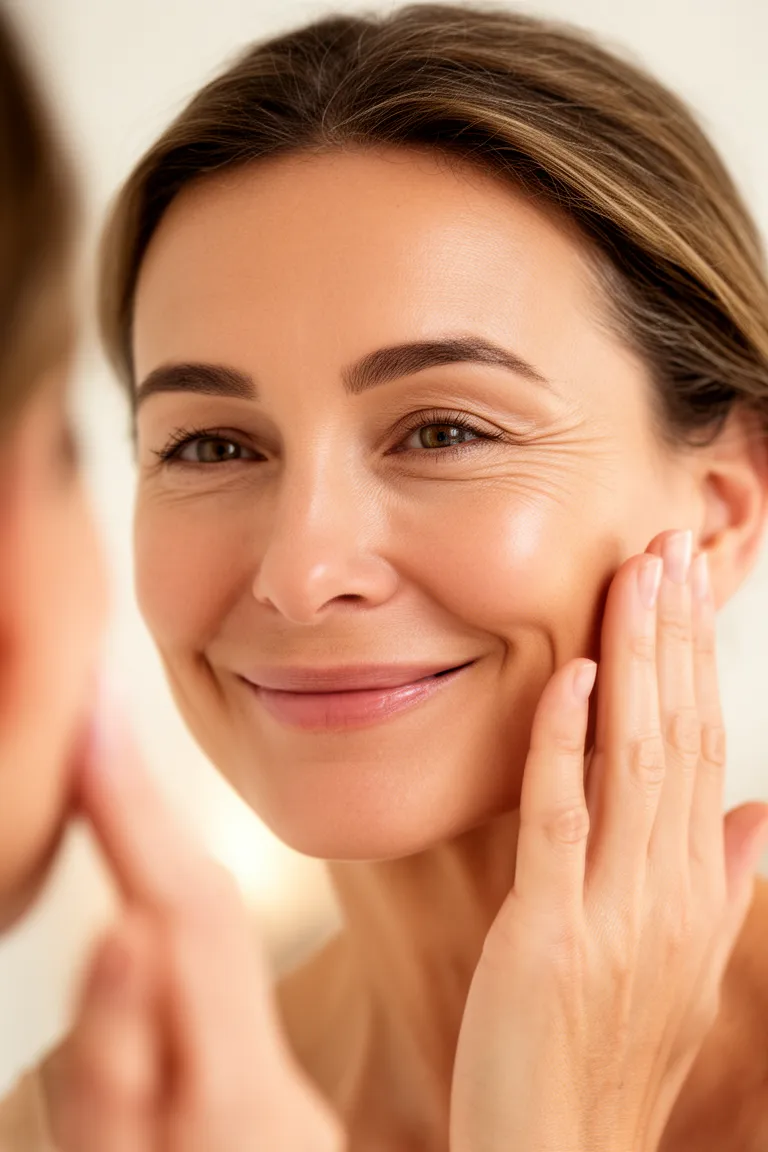
I was in the middle of a video call last spring when it happened. I leaned forward to adjust my screen, and the light from the window caught my face at a new, unforgiving angle. There, along my jawline, was a softness I didn’t recognize. A subtle but definite loss of the defined contour I’d always taken for granted. I sat back, stunned. I’d just turned 47. I ate my greens, drank my water, ran my miles, and slathered on SPF 50 like it was my religion. I’d done the “right” things. So why did my skin look… thinner? Less like my skin and more like a version of it that was slowly deflating?
For weeks, I’d catch my reflection and feel a pang of something between frustration and betrayal. I’d look at the expensive firming creams on my shelf—the ones promising a “lifted,” “sculpted” look—and feel a simmering skepticism. I’d used them faithfully, yet the mirror told a different story. The results were so subtle they were almost imaginary. I felt like I was chasing a ghost, throwing money and hope at a problem that seemed to laugh at my healthy habits. It was the confusing, emotional experience of watching my skin lose elasticity after 40, even though I ate healthy and wore sunscreen religiously.
That moment of clarity on the video call wasn't about vanity. It was the unsettling realization that the rulebook I’d been following had missing pages. I was armed with antioxidants and hydration, but I was losing a battle I didn't fully understand. This is the story of what I learned when I finally stopped looking for a miracle cream and started understanding the science and patience required to genuinely support my skin. It’s about moving from frustration to a quiet, consistent confidence.
The Moment I Realized Healthy Habits Were Not Enough
The confusion was the hardest part. I’d see articles praising the power of diet and sunscreen for youthful skin, and I’d think, “But I do that.” It felt like a personal failure, a secret I was keeping from the wellness world. My skin elasticity after 40 seemed to be dwindling despite my salads and sun protection. The change wasn’t dramatic wrinkles or deep folds; it was a creeping loss of resilience. My skin didn’t bounce back the way it used to. It looked tired, a little papery, and it creased in new places when I smiled—like fabric that had lost its weave. I felt like I was doing the homework but still flunking the pop quiz on aging. That’s the isolating headspace I lived in: convinced I was the only one for whom the rules weren’t working.
I remember standing in a pharmacy aisle, overwhelmed by a wall of jars promising “firming” and “lifting.” I bought one with a hefty price tag, its packaging whispering promises of transformation. For two months, I applied it with ritualistic hope every night. And for two months, I’d scrutinize my jawline in the morning light, searching for a difference that never really materialized. The cream hydrated, sure. It made my skin feel nice. But that fundamental loss of firmness, that elusive elasticity? It remained stubbornly unchanged. That’s when my frustration tipped into a weary determination. If the obvious solution wasn’t working, I needed to go deeper. I needed to understand the why before I could find the how. This was the beginning of my personal quest to figure out how to restore skin elasticity after 40 when creams are not working. If the obvious solution wasn’t working, I needed to go deeper. I needed to understand the why before I could find the how. This was the beginning of my personal quest to figure out how to restore skin elasticity after 40 when creams are not working.
What Actually Changes Skin Elasticity After 40
My journey to understanding began with a simple, humbling admission: I had no idea what “skin elasticity” actually was. I thought it was just a fancy term for tight skin. I was wrong. I learned that elasticity is your skin’s ability to stretch and snap back, like a brand-new rubber band. That snap comes from two key proteins: collagen, which provides the sturdy scaffolding, and elastin, which provides the springy bounce. After 40, our bodies naturally produce less of both, and the quality of what we have degrades—it’s like the support beams in a house slowly weathering from the inside. It’s a slow-motion shift in our very architecture.
But here’s the crucial piece I was missing, the one that finally made my diligent sunscreen use make sense in a new, slightly sobering way: cumulative sun exposure, even with daily SPF, plays a massive long-term role. Think of it like a savings account for your skin’s structure. For decades, UV rays make tiny, invisible withdrawals by breaking down collagen and elastin fibers. My diligent sunscreen use in my 30s and 40s was like starting to save aggressively after I’d already accrued debt. It was preventing new damage, which is absolutely vital, but it couldn’t magically repair the structural loss that had already happened beneath the surface. This explained why is my skin losing elasticity after 40 despite wearing sunscreen. I was protecting the future, but I hadn't been actively repairing the past. Functional integrity of aging skin, from cutaneous biology to anti-aging...
Furthermore, a naturally weakening skin barrier as we age means it’s harder to retain moisture, leading to dehydration that can make skin look even more crepey and less plump, masquerading as lost elasticity. I had to learn to distinguish between hydration (which plumps temporarily like a sponge) and true structural support (which rebuilds the sponge itself, slowly). One gives a fleeting illusion; the other creates lasting change.
The Firming Cream Mistakes That Kept Me Chasing Results
Armed with this new knowledge, I looked back at my years of skincare trials and saw my mistakes with painful clarity. First, I was a chronic product-switcher, a serial monogamist of hope. If a “firming” cream didn’t show dramatic results in four weeks, I’d deem it a failure and move on to the next promising jar. I was treating a biological, years-in-the-making process like a quick software update. No wonder I felt lost.
Second, in my quest for renewal, I was over-exfoliating. Terrified of “dead” skin, I’d use acids and retinoids with aggressive enthusiasm, desperate to “reveal” new, younger skin underneath. But I was likely compromising my skin barrier, making it more vulnerable, inflamed, and leaky—the exact opposite of the calm, stable environment needed for collagen production. I was trying to renovate my house while leaving the front door wide open in a storm.
The biggest mistake, however, was my expectation. I was subconsciously waiting for a cream to perform a miniature facelift. I wanted a visible “lift” of my jawline, a reversal. The reality, as I now understand, is that topical products work on a cellular level to support and protect your skin’s own repair functions. They can’t physically lift tissue that’s being pulled down by gravity and volume loss. That was a sobering but liberating realization. It meant I could stop wasting money on products with unrealistic claims and start investing in a strategic, supportive routine. This mindset shift was the core of my experience restoring skin elasticity after 40.
Building a Routine on Protection, Not Just Correction
I shifted my entire mindset from “attack” to “defend and support.” My new skincare philosophy became less about violently correcting the past and more about tenderly protecting the present and future. The cornerstone, unsurprisingly, was my sunscreen. But now I saw it not as a chore, but as my most powerful anti-aging asset, my daily shield against the very thing that breaks down elasticity. I became religious about applying the right amount (a full teaspoon for face and neck) and reapplying if I was outside for more than a couple of hours. This wasn’t just prevention; it was active protection for the new collagen I was trying to encourage. It was giving my skin a safe space to do its work.
The second pillar was barrier repair, which I had completely overlooked. I swapped out foaming, stripping cleansers for gentle, creamy or balm-based ones. I fell in love with ingredients like ceramides, fatty acids, and cholesterol—the literal mortar between the bricks of your skin cells. A happy, intact barrier is essential for everything else to work. It keeps hydration in, keeps irritants out, and creates the calm, stable environment skin needs to do its natural repair work. I started seeing my moisturizer not as just a layer of slip, but as essential infrastructure. If my skin barrier was a garden, I’d finally stopped flooding it and started nurturing the soil.
The Realistic Pathways to Firmer Skin
Once I understood the core principles—protection, barrier support, and gentle stimulation—I saw that there wasn’t one single path, but a spectrum of approaches depending on your starting point and goals. This realization helped me stop comparing my journey to others and find my own sustainable rhythm. To help visualize the different journeys, here’s a breakdown of the approaches I considered and what I learned about each.
| Approach | Best For | Realistic Timeline for Noticeable Change | Key Consideration |
|---|---|---|---|
| The Foundational Basics | Anyone new to skincare or with sensitive skin needing to rebuild first. | 3–6 months for improved hydration and texture. | This is not about dramatic firming, but creating the healthy base all other strategies rely on. |
| The Consistent Core (My Path) | Those ready to commit to SPF, barrier repair, and one active (like retinol). | 6–9 months for subtle improvements in density and firmness. | Patience is non-negotiable. Results are gradual and cumulative, not overnight. |
| The Enhanced Support Protocol | Individuals who have mastered the core and want to add targeted ingredients (e.g., peptides, growth factors). | May enhance results from the Core path by 3–4 months. | Risk of overcomplication. Adds cost and steps without a strong foundation. |
| Professional-Guided Intervention | Addressing significant laxity or volume loss that topical care cannot reverse. | Varies by treatment; often requires a series. | An extension of home care, not a replacement. Ideal for concerns beyond skin quality. |
Looking at this, I realized I had been skipping steps, jumping straight to "Enhanced Support" with fancy creams without having the "Consistent Core" locked down. I needed to walk before I could run.
Scientific Evidence
My Realistic Timeline for Retinoids, SPF, and Barrier Repair
This is where patience truly became a virtue, not just a cliché. I introduced a retinoid (a gentler over-the-counter retinol to start) with the solemn understanding that this was a five-year friendship, not a one-night stand. I used it just twice a week, “sandwiched” between layers of my barrier-repair moisturizer, and slowly, slowly increased frequency only as my skin tolerated it. I didn’t chase the “retinol uglies” (redness, peeling) as a badge of honor. If my skin got angry, I listened and pulled back. The goal was unwavering consistency over dramatic intensity.
I set my expectations in terms of seasons, not weeks. I told myself I wouldn’t even look for results for a full three months. The first change I noticed wasn’t firmness—it was an overall improvement in texture and a subdued redness around month two. My skin just looked calmer. By month six, I saw it. It wasn’t a snatched jawline. It was a subtle but undeniable improvement in the density of my skin. It looked thicker, more supple, less like thin parchment. The fine lines on my cheeks seemed softer, not because they were filled, but because the skin around them was plumper and more supported. This was the gradual, cumulative effect I had been missing. It was proof that does retinol help restore skin elasticity after 40? Yes, but only as part of a patient, protective partnership with your skin, not as a solo act you bully your face with.
How I Made Skin-Elasticity Care Fit Into My Actual Life
As a busy woman, I knew any routine that wasn’t simple would fail. I distilled everything into a minimal, morning-and-night ritual that takes me five minutes tops. I stopped treating my skincare as a luxury hobby and started treating it as essential maintenance, like brushing my teeth.
My Morning Non-Negotiables (Protection Mode):
- A simple splash with lukewarm water or the gentlest, non-foaming cleanser if I feel I need it.
- A vitamin C serum (a stable, potent antioxidant to team up with my sunscreen and fight free radicals).
- A rich moisturizer packed with ceramides and cholesterol.
- SPF 50, applied generously. Full stop. This is the most important step.
My Evening Sanctuary (Repair Mode):
- A gentle oil or balm cleanser to thoroughly dissolve sunscreen and the day’s grime.
- On retinol nights (three times a week), I let my skin dry completely, apply a pea-sized amount, wait 10 minutes, then slather on my moisturizer.
- On “off” nights, I might use a simple peptide serum or a few drops of a nourishing facial oil, followed by…
- The same rich moisturizer to seal everything in and support overnight repair.
I stopped buying ten different serums that promised the moon. I focused on these pillars: Protect (SPF, Vitamin C), Support (Barrier Repair), and Stimulate (Retinol). Everything else was just noise. This simple, deliberate system is the best skincare routine to restore skin elasticity after 40 that I’ve found—not because it’s magic, but because it’s sustainable, science-backed, and leaves no room for confusion or frantic searching. It finally answered my question of how to restore skin elasticity after 40 naturally—through consistent, intelligent support of my skin’s own biology.
When to Seek Professional Guidance
My final, crucial lesson was learning the respectful boundaries of home care. My routine has given my skin a vitality and resilience I’m deeply happy with—a quality I can feel when I touch my face—but it hasn’t reversed gravity or restored significant volume. For more pronounced laxity or hollowing that truly affects how you see yourself, in-office treatments like laser, radiofrequency, or ultrasound exist for a reason. Seeing a board-certified dermatologist or a trusted, conservative aesthetic professional isn’t a failure of your home routine; it’s a smart acknowledgment that some concerns are structural and mechanical. They can offer options that work on a deeper tissue level than any cream ever could.
For me, understanding this distinction finally dissolved my last bits of frustration and shame. I do what I can consistently and lovingly at home to support my skin’s health from the outside in. And I know, without panic, that for anything beyond that—for the effects of time that no spinach salad can fix—safe and effective professional help is available. It’s not an either/or; it’s a both/and. This knowledge alone brought a peace that was more valuable than any cream.
Frequently Asked Questions
Q: How long does it really take to see actual improvement in skin elasticity, not just hydration? A: You need to think in terms of skin cycles, which are about 28 days. For tangible changes in firmness and density—that feeling of thicker, more resilient skin—you’re looking at a minimum of 3 to 6 months of absolutely consistent routine. The first 4-8 weeks are about calming your skin and improving hydration. True structural improvement is a slow, cumulative process of encouraging new collagen, so patience isn’t just a virtue; it’s a requirement.
Q: I use retinoids and vitamin C and wear sunscreen, but I’m still not seeing results. What am I missing? A: This was my exact dilemma, and the missing link for me was a dedicated focus on my skin barrier. If your barrier is compromised from over-exfoliation, harsh products, or just the natural wear of age, your skin can’t properly utilize the good actives you’re giving it. It’s like trying to fertilize burned soil. Try scaling back all actives for 2-3 weeks and focus solely on gentle cleansing, a ceramide-rich moisturizer, and SPF. Once your skin feels calm, cushioned, and non-reactive, slowly reintroduce your retinoid, once a week to start. The barrier is the foundation for everything.
Q: Are there specific ingredients I should prioritize for elasticity over general anti-aging? A: Focus on a combination of roles. For protection and repair: ceramides, niacinamide, and peptides (like Matrixyl). For collagen stimulation: retinol (or prescription retinoids), and vitamin C (as L-ascorbic acid). Also, don’t underestimate humectants like hyaluronic acid and glycerin that plump the skin, giving the appearance of improved firmness while the other ingredients work on the structure long-term. Avoid getting seduced by a single “miracle” ingredient; it’s the synergy of these categories that creates change.
Q: Is it ever too late to start trying to restore skin elasticity? A: It is never too late to start supporting your skin’s health. While you can’t turn back the clock to 25, you can absolutely improve the quality, hydration, smoothness, and resilience of your skin at any age. Starting a routine focused on protection (SPF) and support (barrier repair, gentle stimulation) will always yield benefits, whether you’re 45, 55, or 65. The goal becomes the best, healthiest version of your skin now, not someone else’s skin from decades ago.
Q: How do I know if my skin concerns are better suited for professional treatments instead of just skincare? A: Skincare is fantastic for improving skin quality: tone, texture, brightness, and providing subtle firming. Professional treatments are designed for more significant structural concerns like pronounced sagging (jowls), deep folds (nasolabial folds), or loss of facial volume that skincare cannot address. A good rule of thumb: if you can gently pinch the skin on your cheek or jawline and it doesn’t snap back quickly, that’s a sign of elastin loss that may benefit from professional modalities. A consultation with a board-certified dermatologist can help you understand your options without pressure.
📌 Love this guide? Save it on Pinterest!
Pin Restore Skin Elasticity After 40: My Honest Journey & What Actually Works 2026 to your board so you can come back to it later.

